
How to Price Your Menu for Real Profit (Pricing Formula + Delivery App Prices)
Price too low and you're working for free; price too high and customers disappear. This article brings together a principled way to price your dishes — from the basic cost-based formula all the way to something no shop can avoid these days: delivery app prices after the GP cut.
Step one: know your cost per plate
A good price starts with an accurate cost. If you've never worked out a detailed cost per plate (including yield, seasoning, gas and packaging), read How to calculate food cost first, then come back and set your prices.
The pricing formula from a target food cost
Example: a plate of pad kaprao with minced pork costs ฿22.70, and you're aiming for a 33% food cost.
Then round it to a price that's "easy to sell", like ฿65 or ฿69. Don't round down too far just because you're worried about losing customers — every baht you round off is profit lost across the whole month.
Delivery app prices — never use your in-store price
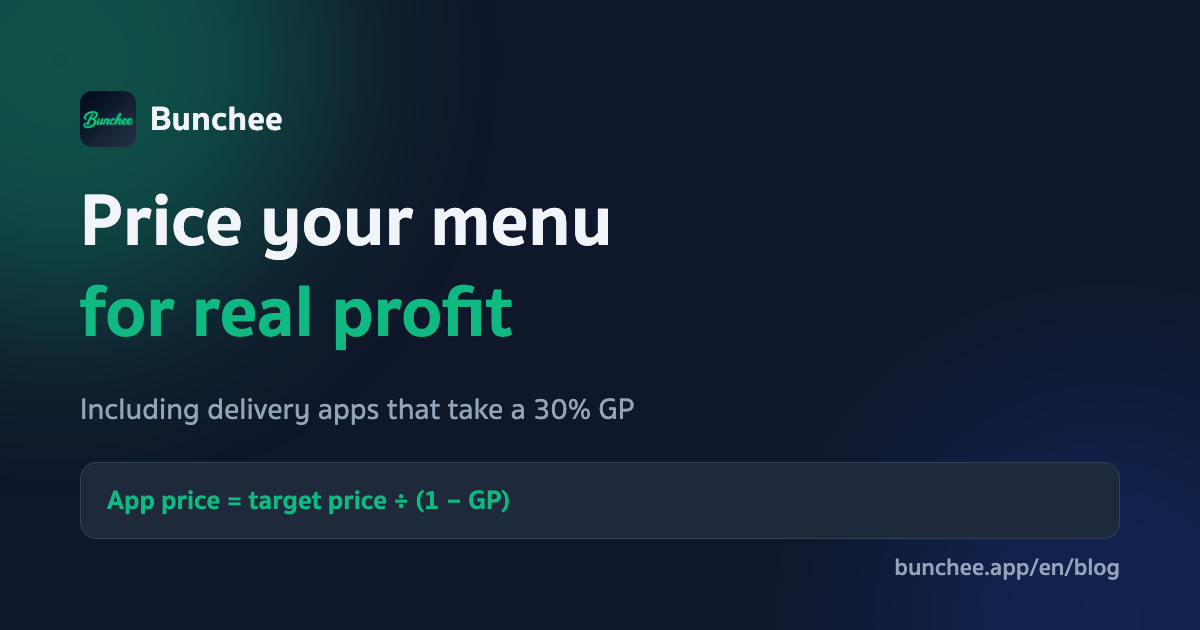
Delivery apps such as GrabFood and LINE MAN take a GP commission of roughly 30–35% of the selling price. If you sell at the same price as in your shop, you're giving away almost all of your profit. The correct formula:
Example: you want ฿60 per plate to reach the shop, and the GP is 30%.
Don't look only at ingredients — rent and labour need room too
A 33% food cost does not mean 67% profit, because rent, wages, water and electricity are still waiting. A healthy cost structure for a typical restaurant looks roughly like this:
| Item | % of sales |
|---|---|
| Ingredients (food cost) | 30–35% |
| Labour (including your own salary) | 20–25% |
| Rent | ≤ 10–15% |
| Water, electricity, gas, other | 5–10% |
| Net profit you should keep | 10–20% |
If your rent is more than 15% of the sales you actually make, either your prices need to go up or your sales need to grow — there's no shortcut around the maths.
Pricing techniques that actually work
- Prices ending in 5 or 9 — ฿59, ฿65, ฿89 feel cheaper than ฿60, ฿70, ฿90, even though the difference is a single baht.
- A high-margin "signature" dish — push dishes with a low food cost that customers still see as good value (egg dishes, stir-fries) and feature them as recommendations.
- Regular / large (phiset) sizes — charge ฿10–15 more for a large, while the extra cost is usually less than half of that difference.
- Set meals + a drink — drinks have a very low food cost (20–25%), so bundling them into a set lifts the average profit on the whole bill.
When to raise prices — and how to do it without losing customers
Signs it's time: your actual food cost has been more than 5 points above target for several months in a row, or a main ingredient has risen by more than 10–15% and isn't coming back down. Ways to raise prices that customers will accept:
- Raise a little at a time (฿5–10) rather than waiting a long time and jumping ฿20 at once.
- Raise prices together with a "visible reason" — an improved recipe, an extra topping, new packaging.
- Avoid quietly shrinking portions — regulars always notice, and their trust is worth more than the cost difference.
- Only raise prices on the dishes whose costs actually went up — there's no need to reprice the whole menu.
You can only spot these moments if you have the data. Shops that record expenses every day can see straight away what share of sales ingredients took this month. The Bunchee app sums it up for you automatically, with ingredient price history charts for each category and an AI assistant you can ask, "How much profit did I make this month?"
Know your real costs, and you can price correctly
Track your shop's income and expenses with Bunchee — free, with AI receipt scanning and automatic daily summaries of sales and costs.